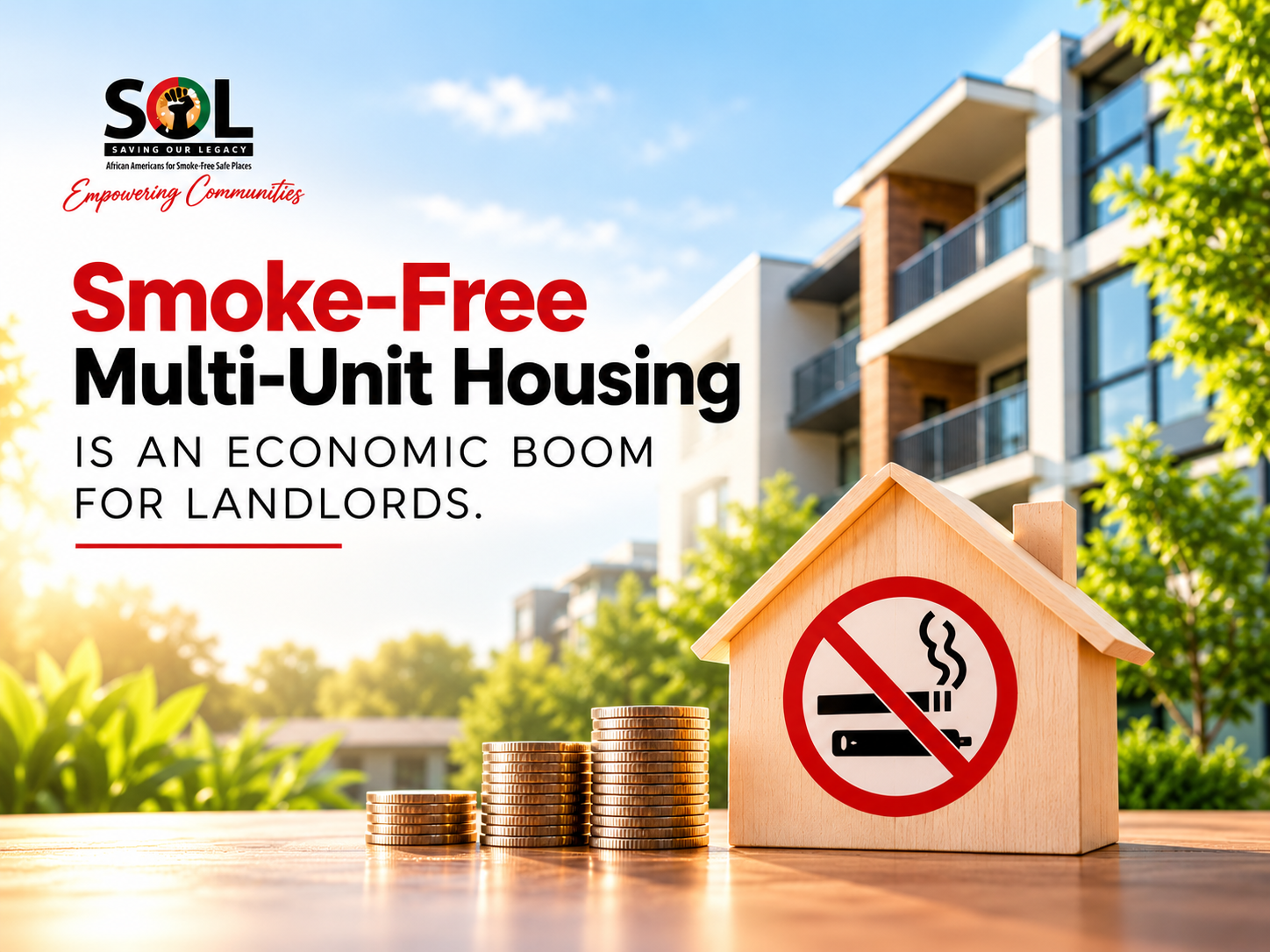
Smoke-Free Multi-Unit Housing Is An Economic Boom for Landlords
by Braylen C. Hill, Summer 2026 SOL Intern
Smoke-free multi-unit housing is an important topic becoming more prevalent in today’s policy scene. With over 100 municipalities in California regulating smokefree multi-unit housing into policy, with countless others across the United States, it is important to discuss the benefits that lie just ahead for landlords in the Sacramento area.
Smoke-free multi-unit housing provides cost-saving measures in just three ways. Firstly, it mitigates repairs and damages caused by residents who smoke or vape for a lease period. In 2009, the National Center for Healthy Housing found that landlords can save $3,000 per unit occupied by smokers. In 2011, UCLA found that a statewide smoke-free multi-unit housing ban could save $18 million statewide, which is $26.6 million in 2026 dollars according to the U.S. Bureau of Labor Statistics adjusting for inflation. It also found that the mean extra cost per unit was just under $5,000 compared to one with smoke-free policies. Another study by the city of San Francisco in 2005 found that repairing two-bedroom apartments inhabited by smokers could cost $8,000 to upwards of $15,000 per unit. The cost could potentially be higher. Smoke and aerosol are known to drift through vents, windows, or any crack, damaging other units via secondhand smoke.
Secondly, a smoke-free policy lowers the insurance premiums charged to landlords, compared to those who permit smoking. Smoking cigarettes or joints requires combustible materials that are susceptible to burning buildings down. Additionally vapes contain lithium-ion batteries that may explode without warning. Although rare, all it takes is once before your building, your livelihood, and your home are gone. The United States Fire Administration attributed 7,600 residential fires to smoking materials alone between 2008 and 2010. The National Fire Protection Association found 15,209 home structure fires from 2019 and 2023 causing $674 million in property damage. The key takeaway is that smoking material fires can happen to anyone’s building, as they have happened across the country. In cases around the country, including Massachusetts, Pierce County, Washington, and San Mateo, California, state researchers found fire insurers or property casualty insurers reduced premiums for buildings with 100% smoke-free housing policies.
Lastly, although many savvy landlords understand changing this policy means losing business, it is to their benefit to know there is still substantial demand for smoke-free multi-unit housing amongst Californian and Sacramento residents. An online California Adult Tobacco Survey conducted by the California Department of Public Health in 2021 in the city of Sacramento found that 64% of adults believe that apartments should be smoke and vape free with 62% saying it should be smoke, vape, and marijuana free. Studies in Los Angeles by UCLA in 2016 found that over 80% of renters would rather live in smoke-free multi-unit housing.
With this information, I challenge landlords to make changes in their building policies, protecting their business investments while also, in turn, protecting their tenants from second-hand smoke and third-hand smoke in the Sacramento and California area. Either way, you are protecting your investments because protecting tenant health is a lucrative long-term investment. Spearhead change today. Contact the Saving Our Legacy Project at our website at https://thesolproject.com or email (info@thesolproject.com), so we can give you resources on your next steps to creating a policy that is cost-effective and health-conscious.